by Terry Heick
Humbleness is an interesting beginning factor for understanding.
In a period of media that is electronic, social, chopped up, and endlessly recirculated, the challenge is no longer access but the top quality of accessibility– and the response to then evaluate uncertainty and “truth.”
Discernment.
On ‘Recognizing’
There is an alluring and warped feeling of “understanding” that can lead to a loss of respect and also entitlement to “recognize things.” If absolutely nothing else, modern-day technology gain access to (in much of the globe) has changed subtlety with phenomenon, and procedure with gain access to.
A mind that is effectively observant is likewise appropriately simple. In An Indigenous Hillside , Wendell Berry points to humbleness and limitations. Standing in the face of all that is unidentified can either be overwhelming– or lighting. Just how would it transform the discovering procedure to start with a tone of humility?
Humbleness is the core of crucial thinking. It says, ‘I do not recognize sufficient to have an enlightened opinion’ or ‘Allow’s find out to minimize uncertainty.’
To be self-aware in your very own understanding, and the restrictions of that knowledge? To clarify what can be recognized, and what can not? To be able to match your understanding with an authentic demand to know– job that normally strengthens critical assuming and continual query
What This Resembles In a Class
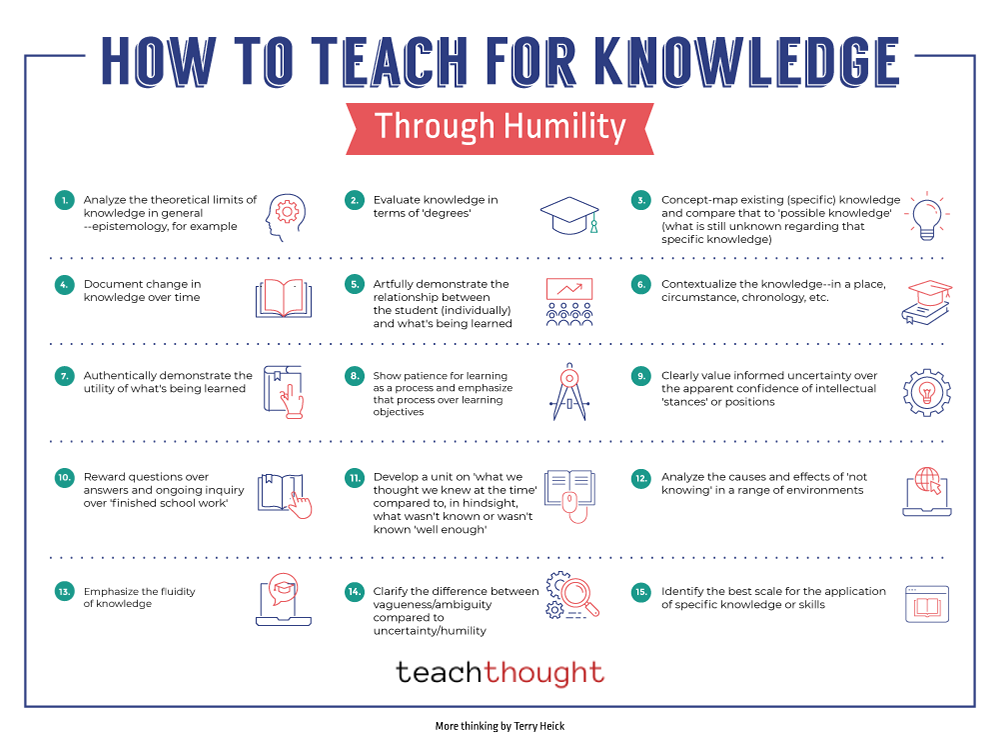
- Assess the limitations of expertise in simple terms (an easy introduction to epistemology).
- Assess expertise in degrees (e.g., particular, likely, possible, not likely).
- Concept-map what is currently recognized about a certain topic and compare it to unanswered questions.
- Record exactly how understanding changes in time (personal knowing logs and historical pictures).
- Demonstrate how each student’s perspective shapes their connection to what’s being found out.
- Contextualize knowledge– area, situation, chronology, stakeholders.
- Demonstrate genuine energy: where and how this expertise is made use of outside college.
- Program perseverance for learning as a procedure and stress that process along with goals.
- Plainly worth enlightened unpredictability over the self-confidence of fast conclusions.
- Compensate continuous questions and follow-up examinations greater than “completed” answers.
- Develop a device on “what we assumed we understood then” versus what hindsight reveals we missed.
- Analyze causes and effects of “not understanding” in science, history, public life, or everyday decisions.
- Highlight the liquid, developing nature of knowledge.
- Distinguish vagueness/ambiguity (absence of quality) from uncertainty/humility (understanding of limits).
- Determine the best range for using details expertise or skills (person, local, systemic).
Study Keep in mind
Study reveals that people that practice intellectual humility– agreeing to admit what they don’t recognize– are more available to finding out and much less most likely to cling to false assurance.
Resource: Leary, M. R., Diebels, K. J., Davisson, E. K., et al. (2017 Cognitive and social attributes of intellectual humility Personality and Social Psychology Notice, 43 (6, 793– 813
Literary Touchstone
Berry, W. (1969 “A Native Hillside,” in The Long-Legged Home New York City: Harcourt.
This idea might seem abstract and even out of location in increasingly “research-based” and “data-driven” systems of knowing. Yet that is part of its value: it helps trainees see understanding not as dealt with, however as a living process they can accompany treatment, proof, and humbleness.
Mentor For Understanding, Knowing With Humbleness